
Drones vs. Humans- Ukraine's Defense Reshuffle
Drones vs. humans is driving the evolution of warfare worldwide. It is also what is driving Zelensky's firing of both his defense minister and the general of his armies at a crucial time.

The story of Ukraine is of a country struggling since 1991 to free itself of Russian influences and throw off its Soviet past. Defense Minister Mykhailo Fedorov’s clash with General Oleksandr Syrskyi, Commander-in-Chief of the Armed Forces of Ukraine, is that struggle in a microcosm.
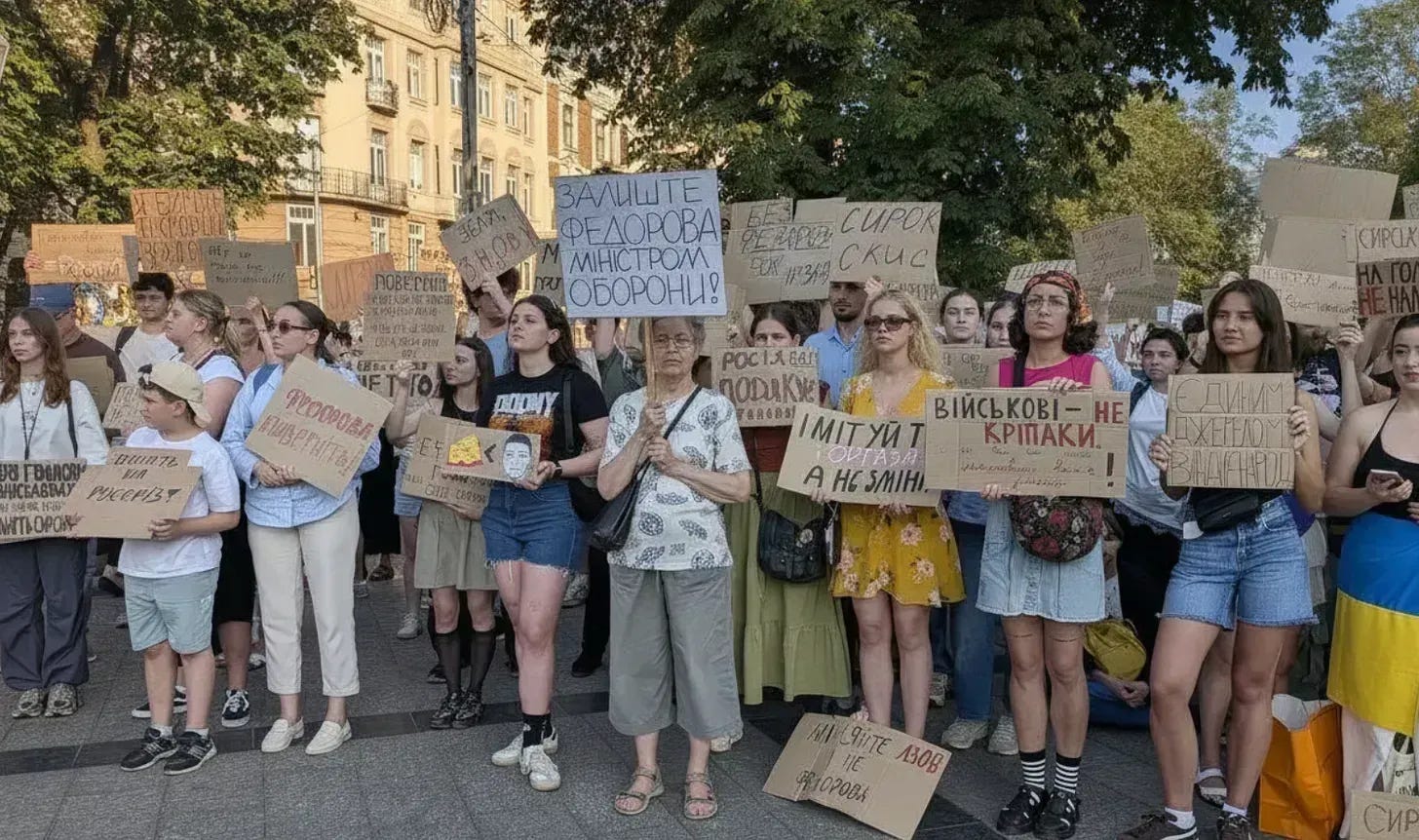
Fedorov and Syrskyi are both without jobs at the moment. Fedorov’s ouster came a week or so ago and Syrskyi’s came after thousands of Ukrainians protested in the streets for days for Zelensky to fire Syrskyi and reinstate Fedorov. As of July 22, latter has yet to happen.
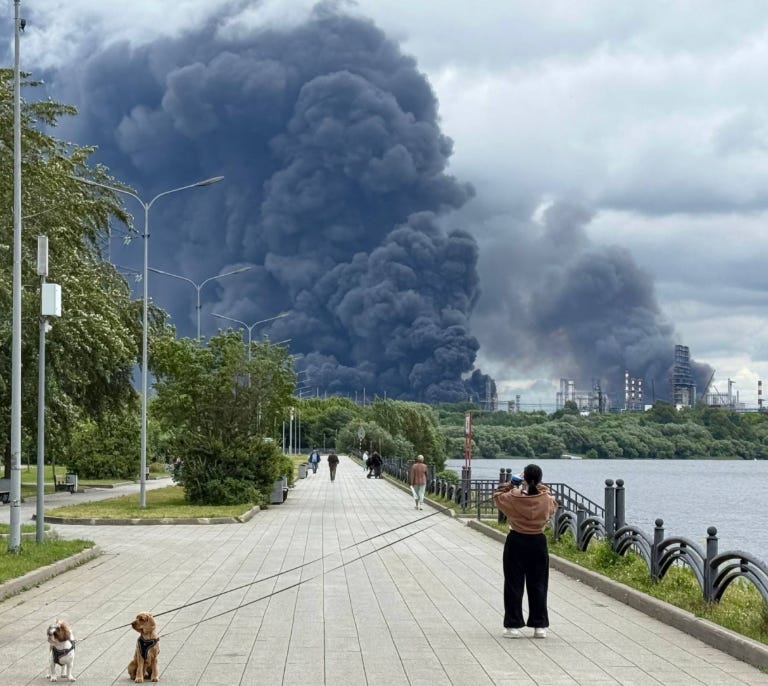
Every month in 2026, Ukraine has caused more Russian casualties than Putin can recruit to replace. In July so far, Ukrainian drones and missiles have taken out 184 Russian ghost fleet tankers transporting oil, cargo ships and military ships in the Black Sea and the adjoining Sea of Azov. This action, the partial destruction of the Kerch Bridge and turning the land route from Russia to Crimea through occupied Ukraine into the “Highway of Death” is choking off Russian control of the Crimean peninsula. Thick plumes of black smoke are now a fixture on the Moscow skyline.
Why on earth would Zelensky fire the team that got him there?
My read is that an internal power struggle went public in the middle of a crucial forty day military campaign. Some say this is by Syrskyi’s design, putting Zelensky in a difficult place that initially made him choose his commander in chief and fire Fedorov. Thousands of protesters put him in another difficult position, resulting in Zelensky firing Syrskyi.
The conflict comes down to this: Fedorov wants to kill Russians using drones. Syrskyi wants to kill Russians using humans.
Fedorov was only appointed defense minister at the beginning of this year. After Fedorov drove Zelensky’s social media election campaign in 2019, the new president appointed him Minister of Digital Transformation, a ministry created for him. Shortly after taking the job, Fedorov declared he would create the '“state in smart phone,” allowing Ukrainians to conduct all their transactions with the government online. About seven months later, he launched Diia. Today, Ukrainians who use the Diia app tell me they can do exactly that - more than 100 governmental transactions can now be handled online. The convenience is not the most important thing to Ukrainians trying to throw off their Soviet past and the corruption that goes with it. With Diia, they no longer have to pay corrupt bureaucrats bribes to get basic services like a drivers license or a marriage license. The Diia app has brought an unprecedented level of transparency.
Fedorov’s wartime victories have been high profile. Two days after the full-scale invasion, while still Minister of Digital Transformation, Fedorov tweeted to Elon Musk, asking him to turn on Starlink for Ukraine. Starlink kept Ukrainian tech workers earning money to fuel the economy and enabled frontline troops to communicate.
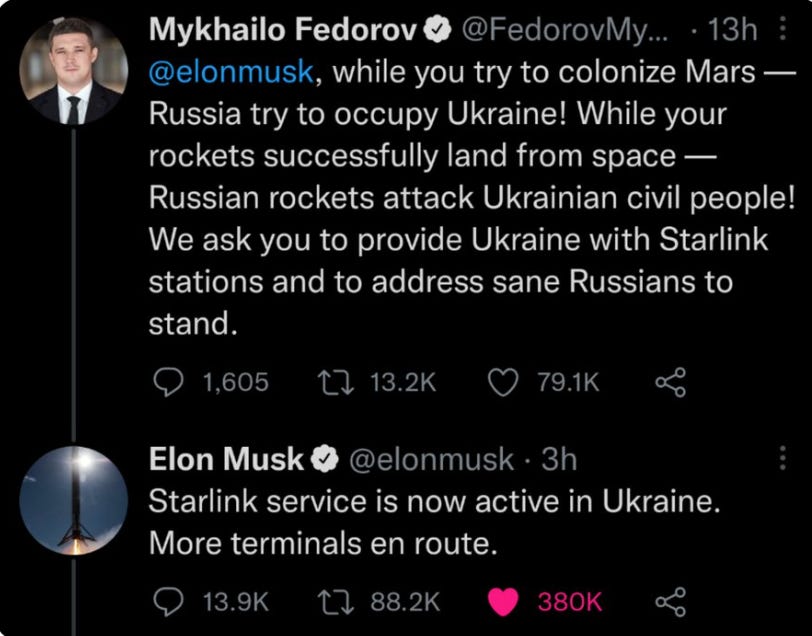
Later, as defense minister, he convinced Musk to turn off Starlink for the Russians. The story goes that Musk told Fedorov dismissively that the only way keep Starlink on for Ukraine and turn it off for the Russians would be to white list every Ukrainian Starlink. Through Diia, Fedorov made the white list in days, impressing Musk enough to eliminate Russian access.
Fedorov also started The Army of Drones in 2022, crowdsourcing the purchase of drones through the Ministry of Digital Transformation, bypassing what was seen as a corrupt and inefficient Ministry of Defense procurement program. He also founded Brave1, a government program that has played a key role in seeding Ukraine’s defense innovation sector. He claims his procurement reforms in the MoD in his short tenure saved $100 million - enough to buy 200,000 more FPV kamikaze drones.
I had occasion to meet a couple of times with officials from Ukroboronprom, the Ukrainian state military manufacturing organization, in late 2022. Caricatures of corrupt and arrogant Soviet-era bureaucrats, they would not meet with me except at expensive Kyiv restaurants. While reforms at Ukroboronprom are ongoing, Fedorov was wise to go around them.
Syrskyi on the other hand is a Soviet-trained general, having graduated from the Moscow Higher Combined Arms Command School in 1986. He was born in Russia, grew up in Kharkiv in the eastern part of Ukraine and is Ukrainian by choice. A Ukrainian-language biographical article from when he was appointed Commander-in-Chief by in February 2024 calls him mathematical and scientific. Although Syrskyi has played a major role in many of Ukraine’s victories - he was the commander who drove the Russians out of the Kyiv region in the first few weeks of the war - he has a lot fewer fans.
Syrskyi was the commander at Bakhmut, a grinding battle from the fall of 2022 to May 2023. Critics say that he held the city longer than he should have, leading to the massive loss of Ukrainian lives. His defenders say he kept Russia’s best forces tied up while Ukraine waited for American weapons. Regardless, the troops started calling him “The Butcher” after Bakhmut.
Further tarnishing Syrksyi’s reputation is “Skeyla-gate.” Skeyla, meaning “cliff” in Ukrainian, is one of several military units collectively known as “Syrskyi’s Regiments,” formed as rapid reaction teams that report directly to Sirskyi rather than through the command structure. Skeyla was investigated by the Ukrainian media for routine disciplinary beatings of soldiers and as many as 26 non-combat deaths inside the regiment’s training center.
Ukraine is having trouble recruiting soldiers. Many Ukrainians say that the Soviet-era military culture under Syrskyi is a big reason.
For someone known for his mathematical prowess, Syrskyi’s methods don’t stand up quantitatively. He is a Soviet general fighting other Soviet generals. The Russian strategy has not changed much since the time of Peter the Great - shove human meat into the war machine. Syrskyi may be more efficient than the Russians at shoving meat, but his strategy is the reason why Ukraine’s critics say it is in a war of attrition that it can’t win.
In November 2023, unnamed American officials gave estimates for Russian and American losses in the New York Times that implied Ukraine’s armed forces were killing about three Russians for every fallen Ukrainian. Russia has more than three times Ukraine’s population, so again, that is a war of attrition Ukraine cannot decisively win.
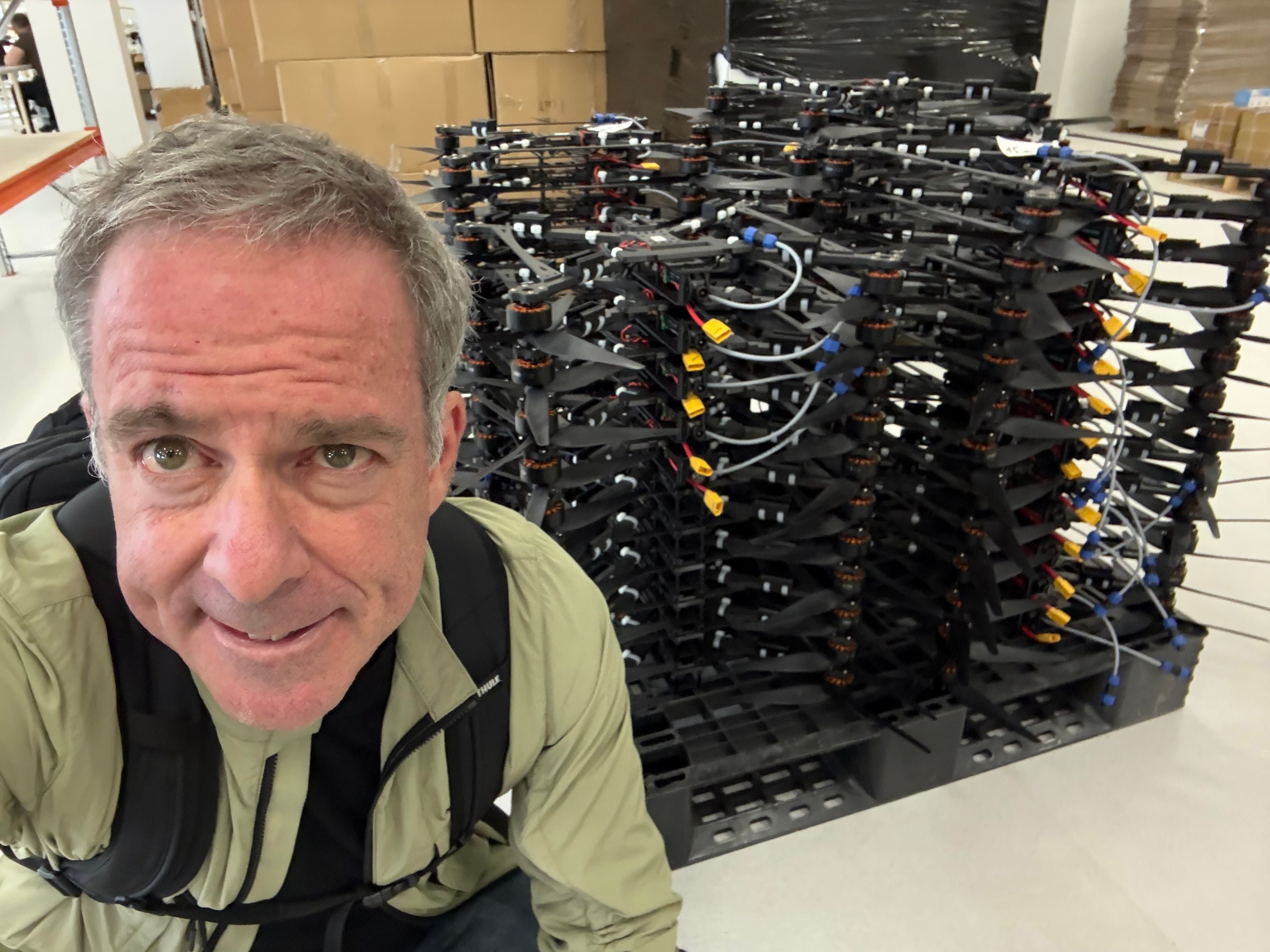
Today, about 95% of the casualties at the front on both sides are from drones. My military doctor friends say they have not treated a gunshot wound in more than a year. In May of this year, Finnish President Alexander Stubb said Ukraine’s kill ratio was five Russians for every Ukrainian death. The US think tank CSIS estimated an eight-to-one ratio. Ukrainian drones, championed by Fedorov, have shrunk the estimated life expectancy of a new Russian recruit at the front to about 35 minutes according to Russian mil bloggers. Technological innovations have now put Russia on the losing side of the war of attrition. Ukraine is on track to build seven million drones this year.
Under Fedorov, the Ministry of Defense has rapidly digitized military functions much like Diia did with civilian activities. Fedorov gamified the drone war. Drone pilots get points for every successful strike against Russian military personnel or armor. Pilots use these points to shop for additional gear on the Brave1 Marketplace. Drones that are effective get purchased more. Units that are effective get more and better gear. The results are transparent.
This is a completely different world than Syrskyi’s, where loyalty, where being one of Syrskyi’s Regiments is the key to getting better equipment. The Soviet holdovers in the military industrial complex have a much tougher time wiring procurement deals for their friends whose companies may not have the performance data behind them. Fedorov’s digital reforms made him quite unpopular in those circles.
Syrski’s replacement is the widely respected Major General Mykhailo Drapatyi. Drapatyi was four years old when Syrskyi was training at the Moscow Higher Military Command School. In contrast to Syrskyi, Drapatyi is known for saving the lives of his soldiers. In 2014, Drapatyi’s unit and several other military units were encircled by Russian separatist troops in Luhansk. Drapatyi took command and led 260 soldiers and more than 30 military vehicles out through 100 miles of shelling, losing only one soldier in the process. He also went viral when a video of an infantry fighting vehicle (IFV) he was driving rammed Russian barricades in Mariupol in 2014 earning the nickname “The Flying IFV.”
Most Ukrainians welcome installation of the new guard of commanders who are not steeped in Soviet strategy and tactics.
Rumor has it that Zelensky has offered Fedorov other positions since relieving him of his duties as minister of defense. Fedorov has turned them all down, awaiting a return to his previous position. Fedorov, 35, would likely be more in sync with the 43-year-old Drapatyi, should he be reinstated. I see this as likely.
This conflict will be resolved. While the personalities may change, Ukraine and the rest of the world will be facing the same conflict - how to integrate drones and other radical new defense tech into existing military structures. Drones and other innovations have put Ukraine in a winning position, but they are not a panacea. Drones currently don’t hold territory. Humans hold territory.
Hopefully, Syrskyi will be a good soldier and approach his departure collaboratively and help Drapatyi keep the victories coming for the good of Ukraine and the Western world.
This piece is going to members of Congress and DC influencers. The Ukraine Freedom Project is able to provide research like this through the generosity of our donors. If you find our work supporting Ukraine’s fight for freedom and pushing for a strong foreign policy valuable, please make a tax deductible donation to support our work.
Sharing this; thanks for the informative and powerful update.
Syrsky's Regiments (each sized of a division +) do not smell well. In 1953, right after Stalin's death it was Zhukov's Divisions vs Beria's Division standoff that decided the fate of the USSR.